Acceptance-rejection method is a method for generating samples from a distribution, for which the probability density function is known, but inverse cumulative probability function is not known, and thus, using the inverse CDF method is not possible.
Although there is quite a lot of information on the topic available, I will try to explain the method the way that I (a.k.a 5-year-old) understand.
Idea
Majorizing distribution
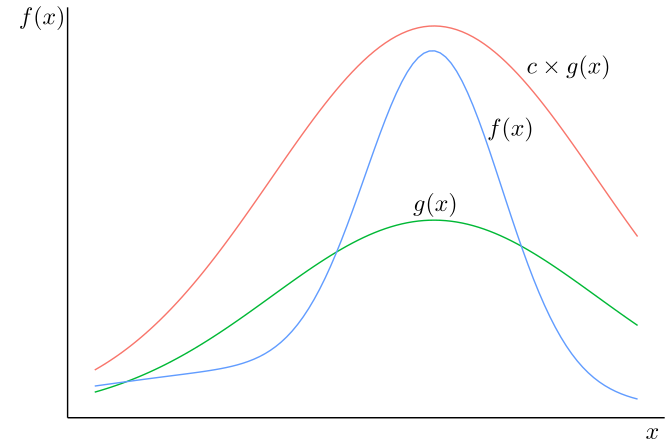
Let us say that we want to draw numbers from some distribution1 $ f(x) $—target distribution—but we have only distribution $ g(x) $, such that by multiplying it with some constant $ c $ it is always larger than $ f(x) $,
$$ \forall x: cg(x) \ge f(x), $$
then $ c g(x)$ is called the majorizing distribution.
Draw a number
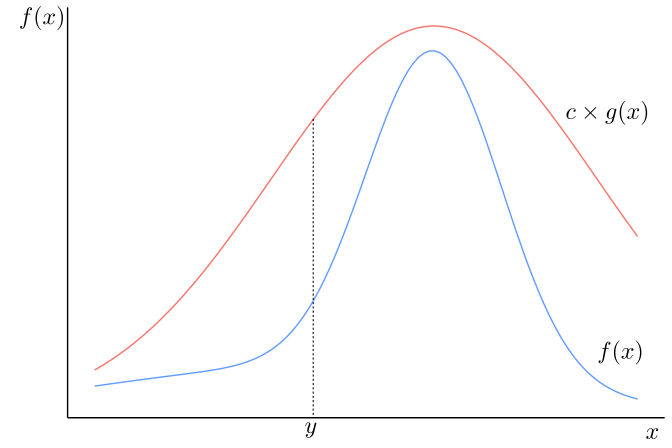
After we have found an appropriate majorizing distribution, we draw a number, $ y $ from $ g(x) $, using any other method (e.g., inverse CDF). We draw numbers from regions with high $ g(x) $ density more often (that is, basically, the definition of density). Thus, if $ g(x) $ is similar to $ f(x) $ then we already get some approximation.
So, let us say that the value of $ y $ appeared to be the following2:
Decide whether to accept or reject it
If we wanted to draw realizations from the $ g(x) $ distribution, we would stop here. However, we want to draw them from another—$f(x)$—distribution. Thus, we have to adjust for it. We know that the actual probability of drawing this number is higher (because $ cg(y) \ge f(x)$), therefore, we want to sometimes discard this number and pretend that nothing happened. In this way, we actually lower the probability of returning this number as the realization of the random variable.
Therefore, we keep this number and claim that this actually is the realization from the target distribution only in
$$ \frac{f(y)}{cg(y)} $$
proportion of cases: there is $ cg(y) $ probability3 to draw this number, but we wanted it to draw only with probability $ f(y) $. This makes much more sense when we visualize it:
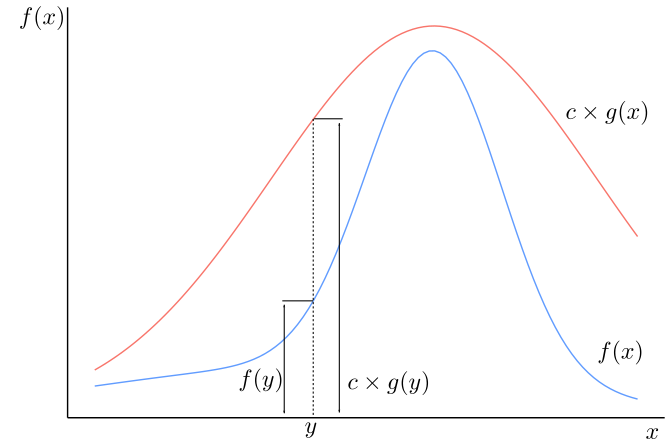
Note that because we have chosen the majorizing distribution to be greater or equal to the target one, the described fraction is always between 0 and 1:
$$ \frac{f(y)}{cg(y)} \in (0;1) . $$
Thus, in order to ensure that we keep it only in the required proportion of cases we draw another random variable, $ u $, from a uniform distribution,
$$ u \sim \operatorname{unif}(0;1) , $$
and accept $ y $ as a realization from $ f(x) $ only if
$$ u \le \frac{f(y)}{cg(y)} , $$
otherwise reject it.
Let us visualize it. Let us consider 3 possible values of $ u $:
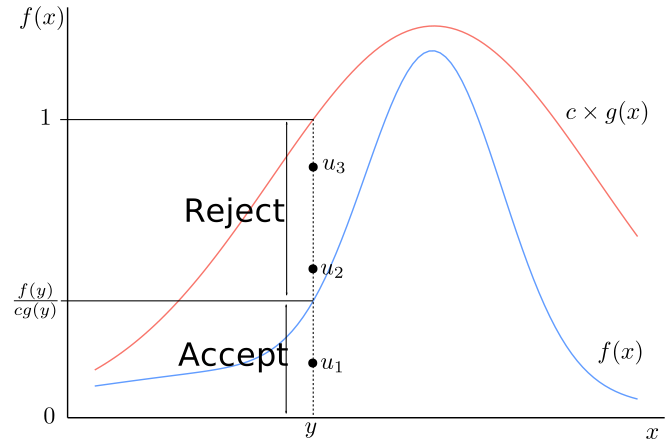
For values $ u_2 $ and $ u_3 $ we would reject $ y $ and for the value $ u_1 $ —accept it. All values of $ u_i $ are equally likely to appear. Moreover, the value $ u $ is equally likely to appear anywhere on the line (because it is sampled from the uniform distribution). Therefore, we accept $y$ in the required proportion of cases.
To sum up, we draw realizations from $cg(y)$ distribution but accept only a fraction of them in order to correct for differences between $cg(y)$ and $f(y)$.
Algorithm
Now it is easy to put this algorithm into pseudo-code:
$$ \begin{align*} 1.&\; \mbox{Generate $y \sim g(x)$} \\ 2.&\; \mbox{Generate $u \sim \operatorname{unif}(0;1)$} \\ 3.&\; \mbox{if}\; u \le \frac{f(y)}{cg(y)}\; \mbox{then} \\ &\; \quad 3.a. \; x = y \\ &\; \mbox{else} \\ &\; \quad 3.b.\; \mbox{go to 1.} \end{align*} $$
Proof4
First, let us find the expected number of draws, $N$, before we finally get a success. It is easy to see that this quantity is geometrically distributed, because that is what the geometric distribution models.
$$ \begin{align} \Pr(N = n) = &\ (1 - p)^{n - 1} p, \quad n \ge 1, \, \operatorname{E}(N) = \frac{1}{p} , \end{align} $$
where $ p $ is probability of success on a given trial.
Second, let us find the value of $ p $:
$$ \begin{align} p = \Pr \left( U \le \frac{f(Y)}{cg(Y)} \right) \label{eq:p} . \end{align} $$
Since $ \frac{f(Y)}{cg(Y)} $ is a random variable itself, let us fix the value of $ Y $ to $ y $ and find $ p \mid Y = y $
$$ \begin{align} p = &\ \Pr \left( U \le \frac{f(Y)}{cg(Y)} \mid Y = y \right) \label{eq:U_cond_on_y_equality} \\ = &\ \Pr \left( U \le \frac{f(y)}{cg(y)} \right) , \end{align} $$
which can be simplified: since $U \sim \operatorname{unif}(0;1)$, we simply integrate $1$, because because the value of $\operatorname{unif}(0;1)$ density function is always 1 on this interval:
$$ \begin{align} p = &\ \int_{0}^{\frac{f(y)}{cg(y)}} 1 dt \\ = &\ \frac{f(y)}{cg(y)} . \end{align} $$
Then we remove the conditioning by integrating over all possible values of $y$
$$ \begin{align} p = & \int_{-\infty}^{+\infty} \frac{f(y)}{cg(y)} \times g(y) dy = \frac{1}{c} \int_{-\infty}^{+\infty} f(y) \frac{g(y)}{g(y)} dy \\ = &\ \frac{1}{c} \underbrace{\int_{-\infty}^{+\infty} f(y) dy }_{1} = \frac{1}{c} \times 1 = \frac{1}{c} \label{eq:t} , \end{align} $$
where the integral in (\ref{eq:t}) is equal to $1$, because $f(y)$ is a proper density function and it integrates to $1$.
Now recall the Bayes’ theorem:
$$ \begin{align} \Pr (A \mid B) = \frac{\Pr(B \mid A) \Pr(A)}{\Pr(B)} \label{eq:bayes}. \end{align} $$
In our case
$$ \begin{align} \Pr(A) = &\ \Pr(Y \le y) \\ \Pr(B) = &\ \Pr \left( U \le \frac{f(Y)}{cg(Y)} \right) = p = \frac{1}{c} \label{eq:pr_B} , \end{align} $$
where (\ref{eq:pr_B}) is true, because it is the same as (\ref{eq:p}). Thereore, with the above definitions of $A$ and $B$ (\ref{eq:bayes}) becomes
$$ \begin{align} \Pr \left( Y \le y \mid U \le \frac{f(Y)}{cg(Y)} \right) = &\ \Pr \left( U \le \frac{f(Y)}{cg(Y)} \mid Y \le y \right) \times \frac{G(Y)}{\frac{1}{c}} \label{eq:bayes_substituted} . \end{align} $$
From the definitions of conditional probability it follows that
$$ \begin{align} \Pr(B \mid A) = \frac{\Pr(B, A)}{\Pr(A)} , \end{align} $$
and therefore we can express a term in (\ref{eq:bayes_substituted}) as
$$ \begin{align} \Pr \left( U \le \frac{f(Y)}{cg(Y)} \mid Y \le y \right) = &\ \frac{\Pr \left(U \le \frac{f(Y)}{cg(Y)} , \Pr(Y \le y \right)}{\Pr(Y \le y )} \nonumber \\ = &\ \frac{\Pr \left(U \le \frac{f(Y)}{cg(Y)} , Y \le y \right)}{G(y)} . \end{align} $$
We know that $Y$ and $U$ are statistically independent, therefore
$$ \begin{align} \frac{\Pr \left(U \le \frac{f(Y)}{cg(Y)} , Y \le y \right)}{G(y)} =&\ \frac{\Pr \left(U \le \frac{f(Y)}{cg(Y)} \mid Y \le y \right)}{G(y)} . \end{align} $$
It is something very familiar. And indeed, it is almost the same equation as (\ref{eq:U_cond_on_y_equality}), with the only difference being that instead of $Y = y$, we now have $Y \le y$. Thus, we need to integrate it for all values of $Y \in (-\infty; y)$ (also, note that $y$ is a constant and therefore we can take $G(y)$ out of the integration sign):
$$ \begin{align} \frac{\Pr \left(U \le \frac{f(Y)}{cg(Y)} \mid Y \le y \right)}{G(y)} = &\ \frac{1}{G(Y)} \int_{-\infty}^{y} \frac{f(w)}{cg(w)} g(w) dw \nonumber \\ = &\ \frac{1}{c G(Y)} \underbrace{\int_{-\infty}^{y} f(w) dw}_{F(y)} = \frac{F(y)}{cG(y)} \label{eq:U_cond_on_y_inequality}. \end{align} $$
Substituting (\ref{eq:U_cond_on_y_inequality}) back into (\ref{eq:bayes_substituted}) we get
$$ \begin{align} \Pr \left( Y \le y \mid U \le \frac{f(Y)}{cg(Y)} \right) = \frac{F(y)}{cG(y)} \times c G(Y) = F(y) . \end{align} $$
Thus, accepting values $y$ sampled from a majorizing distribution with probability $\frac{f(y)}{cg(y)}$ is the same as sampling from $F(y)$ directly.
Notes
As we will see later, this method depends only on the ratio of the target distribution to an arbitrary distribution, which density is arbitrary scaled. Thus, the method works even if only know a function to which the target distribution is proportional: “target distribution is known up to a multiplicative constant”. ↩︎
Since $cg(x)$ is just a scaled version of $g(x)$, we will not show it on the illustrations anymore. ↩︎
Technically, this is not probability, because we are talking about continuous distributions, but this should be close enough for intuition. ↩︎